本文 2 個章節 · 查看目錄
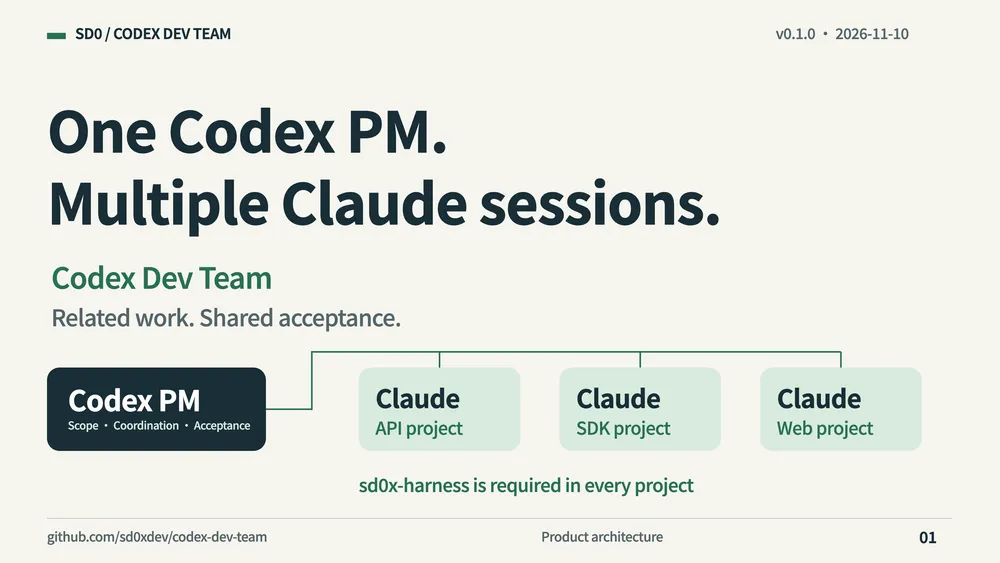
I have open-sourced Codex Dev Team, a Codex skill that turns one Codex conversation into a project manager for one or more Claude Code conversations. Codex assigns work, coordinates dependencies, and checks the final result. Claude handles implementation and tests, then completes independent review and verification through sd0x-harness.
Source and installation
The project is open source at sd0xdev/codex-dev-team. These instructions use v0.1.0, the release discussed in this article. See the English installation guide for the full procedure.
You need macOS or Linux, Codex with skills support, Python 3.9+, Git, tmux, and an authenticated Claude Code installation. Paste this into a Codex conversation:
Use $skill-installer to install this skill:
https://github.com/sd0xdev/codex-dev-team/tree/v0.1.0/skills/codex-dev-team
If the skill does not appear after installation, start a new Codex session. Each development project also needs the full sd0x-harness Claude Code plugin. Complete /project-setup, restart Claude Code, and check that the rules, hooks, runners, and settings are active. Installing the Dev Team skill does not perform this project setup automatically; Codex can help check readiness and arrange the setup work first.
Once installed, start with this prompt, replacing the brackets with your idea:
Use $codex-dev-team to explore this requirement: [describe the problem or experience].
Help me clarify the users, scope, and acceptance criteria, and check sd0x-harness readiness.
Address missing setup first. Before implementation, confirm the model and execution permissions.
I want this skill to make software development accessible to a broader audience, including creative professionals, designers, and product people. Working directly with sd0x-harness calls for a stronger engineering background: understanding project structure, tests, reviews, and acceptance is part of using it effectively. Codex Dev Team adds a layer of conversation and coordination around that workflow. Users can begin with a problem or an experience they want to create, while Codex helps turn it into actionable, verifiable engineering work supported by the harness.
It is designed for related work that needs to come together. A feature spanning a frontend, an API, and a shared SDK can have three Claude conversations, each responsible for one project, while the same Codex PM keeps their contracts aligned, tracks changes, and checks the real integration. A focused task can still use a single Claude conversation. The workflow addresses the handoffs between pieces of work and the evidence needed to establish that the whole feature is complete.
Version 0.1.0 was released on November 10, 2026, with installation instructions and examples on GitHub. Every target project must have the full sd0x-harness Claude Code plugin configured and ready. Before adding more conversations, each assignment needs clear ownership and conditions for completion.
In an earlier article about AI teams (Traditional Chinese), I described the move from one development loop to several streams of work progressing at once. This release makes one part of that approach available to others: once Claude can take responsibility for a substantial piece of implementation, how should the surrounding workflow assign it, track its dependencies, and decide whether the result is actually complete?
That surrounding work is easy to underestimate. Opening more conversations is straightforward. Keeping their assumptions aligned is harder. An API field changes, the SDK continues generating types from an older specification, and the frontend finishes its interface using a different fixture. All three appear to be making progress. The disagreement only becomes visible when they are connected. More conversations bring more handoffs and more work to keep those handoffs consistent.
I want Codex to have a clear management role here. It works with the user to establish the problem, then records the architectural constraints, file ownership, dependency order, and acceptance criteria in a mission before assigning it to the appropriate Claude conversation. Claude chooses how to implement the work within those boundaries, completes the code, tests, and the project’s required review and verification, and returns results that can be checked. Once Claude has stopped editing, Codex examines the outcome as a whole and determines which criteria are satisfied and which require another revision.
Requirements can still emerge through a flexible conversation. A creative professional can start with an interaction they imagine; a product person can start with a difficulty users face. Together with Codex, they can compare directions, clarify constraints, and decide on the first small piece to build. For an activity page, the initial question might be whether users need to find a particular action or follow a process over time. That distinction can guide the search, filtering, and presentation choices. During exploration, every idea does not need to become a development assignment immediately. Once there is agreement on a direction, Codex gives Claude a bounded scope and acceptance criteria. If the idea changes later, Codex identifies the consequences and updates the work, keeping a clear handoff between exploration and implementation.
With this additional layer, my aim is to bring the quality of the resulting software closer to what a professional team would work toward. Requirements, architectural tradeoffs, tests, independent review, and integration acceptance receive ongoing attention. Users can discuss what is complete and where gaps remain. Creative and product judgment can carry through from the initial idea to a result that can be evaluated. Quality still has to be demonstrated in the actual work, and environment setup and engineering judgment remain necessary. The skill helps more people bring those practices into their own development process.
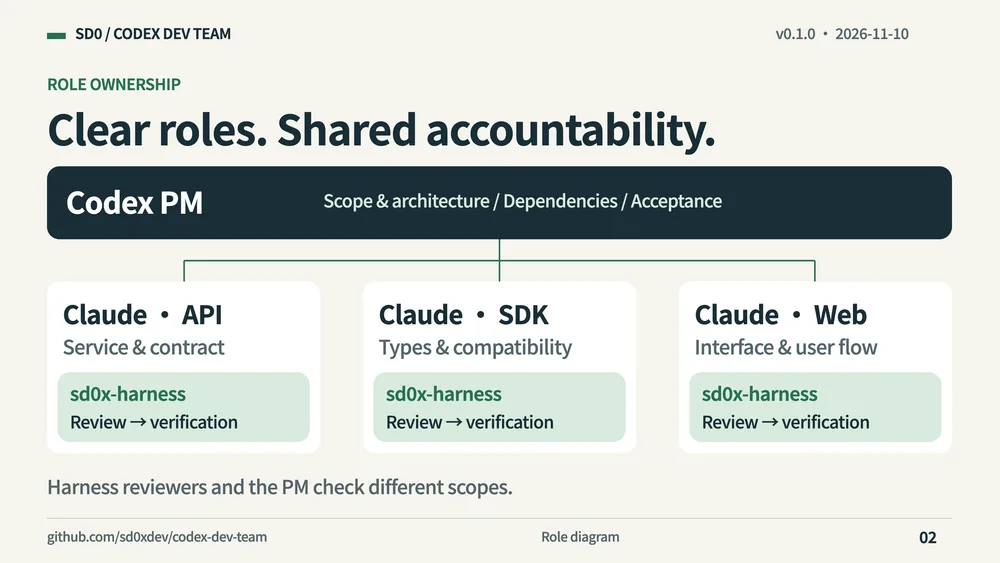
The outer Codex PM assigns work and checks overall acceptance. Each Claude development conversation retains its own harness review and verification workflow. The independent reviewer launched by the harness has a separate role from the PM.
This is why I deliberately kept one dependency in the public version: every target project must use the full sd0x-harness Claude Code plugin.
If I delegate development to Claude without preserving the conditions for completing it, the outer PM has to keep asking the same questions. Were the tests run? Did an independent reviewer examine this version? Does the verification still apply after the last edit? I have already organized those requirements in the harness. Dev Team builds on that foundation and concentrates on coordination between tasks and acceptance of the combined result.
That dependency has a real setup cost. Installing the skill does not eliminate the need to check Claude Code, authentication, or the execution environment. Each repository’s rules, hooks, runners, and settings must actually be loaded and effective. Finding the plugin somewhere on the machine, or installing a skills-only package in Codex, is not enough to begin this workflow. If configuration is missing, the first assignment is limited to setup. After the changes are complete, a new process loads them, and the effective configuration is checked again. If the environment is still not ready, the missing pieces remain explicit.
I am willing to keep that requirement because it gives “complete” a common starting point in every mission. The harness’s own status still needs careful interpretation, though. A review hook may only be a reminder. A process continuing without being blocked does not mean an independent reviewer has returned a passing verdict. The evidence is in the original reports and verification output corresponding to the final edits, together with the requirements the work was meant to satisfy. The outer Codex PM cannot substitute an internal pass for its own acceptance check.
Consider a searchable activity page spread across three repositories: Web, API, and SDK. This is an illustrative workflow from the public documentation, rather than a real project completed as part of this release.
Codex first establishes the API request and response formats, pagination rules, error behavior, and what the user should see on the screen. Once those contracts are stable, three Claude conversations take responsibility for the service, client SDK, and interface. Each has a repository, an allowed set of files, a session ID, and a handoff. Work that can proceed independently runs in parallel. Work that depends on an upstream decision is recorded in the shared task ledger.
Suppose the API developer discovers that a field needs a different design. That change goes back to Codex, which updates the shared contract and passes the revision to the affected conversations. The SDK should not have to guess how to preserve compatibility. The frontend should not quietly treat a temporary fixture as the final service. Someone needs to manage these changes while the work is still in progress, before the differences accumulate into an integration problem.
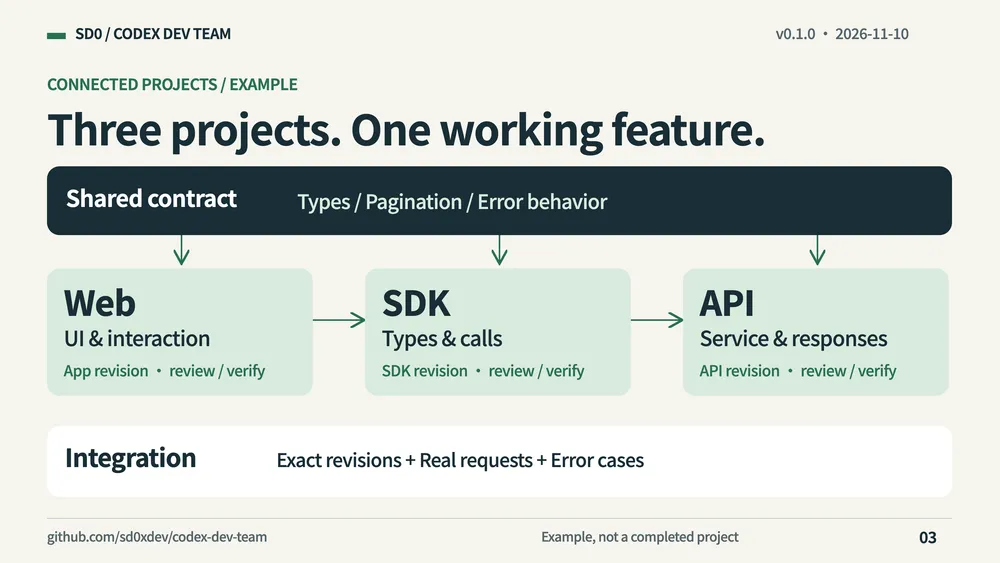
Illustrative workflow: establish a shared contract, develop and verify each component, then test the real Web → SDK → API path using exact component revisions. Fixtures and isolated project tests do not replace integration evidence.
When the components are handed back, there is still integration work to do. A designated integration owner connects the exact revisions, while Codex checks whether real requests complete the intended path and whether the required failure cases are handled. Three passing unit-test suites establish only what each suite covers. Whether the complete activity page works requires additional evidence. If the assignment ends at local acceptance, that is where its status stops. It does not become “deployed” in the handoff.
For that reason, I recommend keeping related features within the same Codex PM conversation. They share a goal, contracts, and an integrated result, so there is a practical reason for one management conversation to hold that context. Putting unrelated work into the same long conversation can mix decisions and acceptance criteria that do not belong together. And when a single Claude conversation can finish a focused feature well, there is no need to split it into three.
Parallel work inside one repository needs even more care. The interface and an adapter may have separate owners, but shared types, lockfiles, and Git operations still need explicit ownership. When the files overlap, either work sequentially or use isolated worktrees with one owner responsible for integration. Every additional worker also adds model usage, another state to track, and another handoff that can be misunderstood.
The public version preserves a few operational details that can seem minor until work needs to be resumed. Each run records its own tmux socket, pane, and Claude session, and continuation uses the recorded conversation identity. Interactive mode starts Remote Control first, checks the current session, actual model, and empty idle prompt, and only then dispatches the mission. A saved RC URL does not establish that the session is connected now. Text already present in the prompt must not be silently cleared or submitted on the user’s behalf.
Waiting requires some discipline as well. A local program can observe state and return an event that needs Codex’s attention, without repeatedly asking a model to reread the conversation and report progress. The watcher itself makes no model calls, but Claude’s development work and the host’s handling of tool results still consume resources. Terminal-state detection can also miss a change. A timeout is a reason to inspect the run, not sufficient evidence that execution has failed.
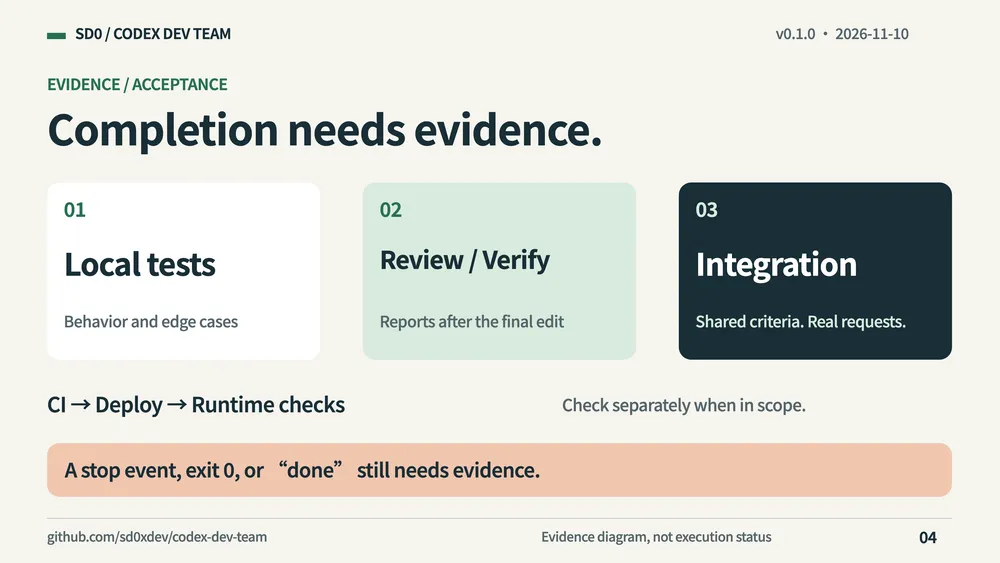
Local tests, independent review and verification, and integration acceptance each need their own evidence. CI, deployment, and runtime checks are assessed separately when they are part of the assignment. A stop event or a “done” message prompts inspection; it does not close acceptance.
The public version requires an explicit available model, while reasoning effort can follow the execution environment’s configuration. When continuing work, it must resume the correct conversation, avoid blindly resending a mission, and make sure acceptance evidence corresponds to the final changes.
Before releasing v0.1.0, I ran 50 offline tests covering the runner, watcher, and installer. CI also passed on macOS and Linux across two Python versions. I then downloaded a fresh copy of the public tag without GitHub credentials and checked that the installed files matched the release source. Those checks support the tooling and installation path. They do not establish that every real development task will succeed, or that more conversations will always finish the work sooner. Model availability, RC connectivity, and cross-project delivery still need to be verified in the environment where the skill is used.
Codex Dev Team is now on GitHub, with installation instructions and examples in English and Traditional Chinese. You can ask Codex’s skill-installer to install a specific release, then start with a feature whose boundaries are clear. Let it check harness readiness, assign the mission, and return the evidence. See whether that handoff is understandable before deciding whether the next feature would benefit from multiple conversations.
For creative professionals and product people, this division of responsibilities creates more room to focus on the problem, the experience, and the value, while engineering quality remains part of the work. People still decide what deserves to be built, which tradeoffs are acceptable, and when more resources are justified. Codex turns an evolving discussion into tasks and decisions; Claude implements the work and returns evidence. When we return to a feature, we should be able to discuss what it still needs and where it should go next, with the work supporting those decisions close at hand.